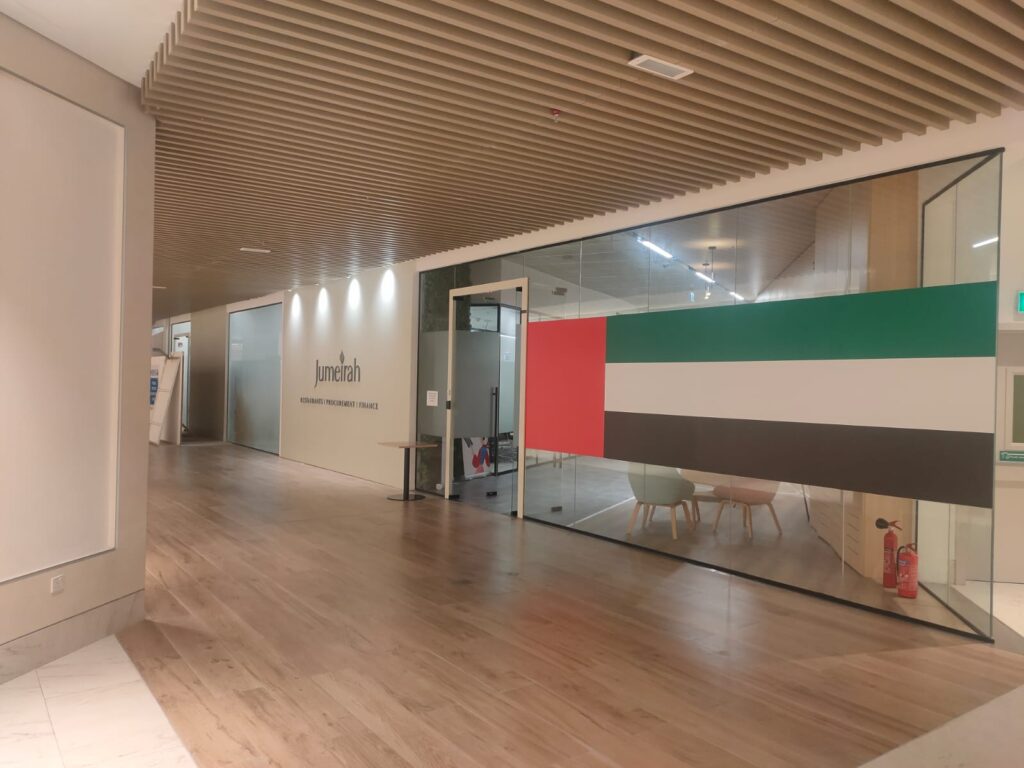
Frameless Glass Partitions in Dubai: The Complete Buyer’s Guide for 2026
By the Glasser Technical Works LLC team — glass & aluminium specialists serving Dubai and the wider UAE since 2019.
Quick answer: Frameless glass partitions are floor-to-ceiling tempered glass dividers fixed with minimal hardware instead of bulky frames. In Dubai they typically cost AED 350–850 per square metre installed, take 7–14 days from survey to handover, and are most popular for offices, villas and retail fit-outs because they divide space without blocking natural light. Always confirm the glass is toughened safety glass and the contractor follows UAE fire and life-safety guidance.
Why Dubai fell in love with frameless glass
Walk into any new tower in Business Bay, a DIFC office floor or a freshly handed-over villa on the Palm, and you will notice the same design language: light moving freely from one room to the next, uninterrupted by walls. That openness is rarely an accident. It is usually a frameless glass partition doing quiet, deliberate work.
Dubai is a city of strong daylight and premium real estate, which makes natural light one of the most valuable things a fit-out can protect. Solid partition walls carve up floor plates and trap light in the rooms nearest the windows. Frameless glass does the opposite — it defines a space acoustically and visually while letting daylight reach deep into the floor plan. For developers and tenants paying Dubai rents per square foot, a partition that makes an interior feel larger and brighter is not a luxury; it is a commercial decision.
Over the past seven years our team has installed partition systems across more than a thousand residential, commercial and hospitality projects in the Emirates. The pattern is consistent: clients arrive asking about glass, and they stay for what glass does to a space — it modernises an office overnight, it future-proofs a villa for resale, and it signals a level of finish that drywall simply cannot match.
What exactly is a frameless glass partition?
A frameless glass partition is an interior divider made from large panes of toughened (tempered) glass held in place by discreet hardware — typically a slim floor and ceiling channel, point-fixed clamps, or minimal patch fittings — rather than a continuous metal frame around every pane. The result is a near-seamless wall of glass with only hairline joints between panels.
“Frameless” does not mean “no hardware.” It means the hardware is reduced to the minimum needed for structural safety and stays visually recessed. The categories you will most often hear in Dubai are:
- Single-glazed frameless: one pane of 10mm or 12mm toughened glass per opening. The cleanest, most economical look — ideal for meeting rooms, reception areas and villa stairwells.
- Double-glazed (acoustic) frameless: two panes with a sealed cavity for serious sound control. The choice for boardrooms, clinics and managing-director offices.
- Switchable smart-glass: glass that turns from clear to opaque at the press of a button using an electric (PDLC) film. A premium privacy solution for executive suites and consultation rooms.
- Fire-rated glass partitions: specially engineered systems that hold back smoke and flame for a rated period, used where the building’s fire strategy requires compartmentation.
Types of frameless glass partition explained
Clear and low-iron glass
Standard float glass carries a faint green tint, most visible at the edges and on large panes. Low-iron (extra-clear) glass removes that cast for a truly colourless, water-white finish. On a feature partition in a luxury villa or a flagship retail unit, low-iron glass is worth the modest premium because the difference is obvious in Dubai’s bright interiors.
Acoustic double-glazed partitions
Open-plan offices look beautiful and sound terrible. An acoustic glass partition uses two panes separated by an air or gas cavity, often with laminated interlayers, to absorb and block sound. In our installations these systems reduce transmitted noise by roughly 42–48 decibels — enough to turn a glass-walled boardroom into a genuinely private space where a confidential call stays confidential.
Fluted, reeded and textured glass
When you want light without a clear line of sight, textured glass is the answer. Fluted and reeded patterns have become a defining look in Dubai hospitality and boutique offices — they diffuse light, add tactile richness, and provide soft privacy without resorting to film or blinds.
Switchable smart glass
Privacy on demand. A low-voltage current realigns particles inside a laminated film so the glass flips between transparent and frosted in under a second. It is the most expensive option per square metre, but for a CEO’s office or a medical consultation room it replaces both a wall and a blind in a single elegant system.
Fire-rated glass systems
Some partitions exist to protect people, not just to look good. Fire-rated glass partitions are engineered and certified to resist fire and smoke for a defined period — commonly 30, 60 or 120 minutes — and are specified wherever a building’s approved fire strategy calls for them. These are not interchangeable with decorative glass and must be supplied as a complete, tested assembly.
How much do frameless glass partitions cost in Dubai?
This is the first question almost every client asks, and the honest answer is “it depends” — but you deserve real numbers, not a brush-off. As a working guide, here are indicative supplied-and-installed rates in the Dubai market:
| Partition type | Indicative price (installed) | Best for |
|---|---|---|
| Single-glazed clear (10–12mm) | AED 350–550 / m² | Meeting rooms, reception, villas |
| Low-iron / extra-clear | AED 450–650 / m² | Feature walls, luxury interiors |
| Fluted / reeded textured | AED 500–750 / m² | Hospitality, boutique offices |
| Double-glazed acoustic | AED 600–850 / m² | Boardrooms, clinics, executive offices |
| Switchable smart glass | AED 1,800–3,500 / m² | Privacy-on-demand executive suites |
| Fire-rated systems | AED 1,200–2,500 / m² | Compartmentation per fire strategy |
Several factors move the number within these bands:
- Glass thickness and type — 12mm costs more than 10mm; laminated and low-iron carry premiums.
- Hardware finish — brushed steel, matte black and brass-effect fittings vary in price.
- Doors and openings — integrated pivot, sliding or hinged glass doors add cost versus a fixed run.
- Site complexity — high floors, restricted access, out-of-hours work in occupied offices, and uneven structural openings all affect the install rate.
- Project size — larger continuous runs usually achieve a better rate per square metre than a single small screen.
Beware of quotes that look dramatically cheaper than the market. In glass, the saving almost always comes from thinner panes, lower-grade hardware, or skipping the certified toughening process — none of which you want in a hot climate or a public building.
Safety and UAE compliance: the part nobody should skip
A glass partition is a piece of structural safety equipment as much as a design element. If it ever breaks, it must break safely. That is why every reputable installer in the Emirates works exclusively with toughened (tempered) safety glass, which is heat-treated to be several times stronger than ordinary glass and, crucially, shatters into small blunt granules instead of dangerous shards.
When you evaluate a contractor, look for alignment with recognised glass standards such as EN 12150 (thermally toughened safety glass) and impact-classification testing under EN 12600 / BS 6206, or the equivalent ASTM heat-treated glass specification. For any commercial fit-out, the project must also respect the building’s fire and life-safety requirements — in Dubai that means working within the framework of the UAE Fire and Life Safety Code of Practice administered by Dubai Civil Defence, particularly where partitions sit on escape routes or require a fire rating.
Energy efficiency matters too. Dubai’s Al Sa’fat green-building system and the wider push for thermal performance mean that glass specifications — especially for any partition adjacent to the building envelope — should be chosen with heat and light in mind. A specialist who raises these points unprompted is a specialist worth hiring.
Offices vs villas: choosing the right system
For Dubai offices and commercial fit-outs
In a workplace, partitions do three jobs at once: they create rooms, they manage acoustics, and they project the company’s brand to every visitor who steps off the lift. Single-glazed clear glass suits open meeting pods and collaboration zones. Acoustic double-glazed systems belong around boardrooms, HR offices and any space where conversations must stay private. Many of our office clients pair glass partitions with matching aluminium framed doors for a coordinated, durable finish that handles heavy daily traffic. You can see a real example in our Dubai office partition project.
For villas and residential spaces
At home the priorities shift to elegance and light. Frameless glass shines on staircases as a near-invisible balustrade, around home offices and gyms, and as a partition between living and dining areas that keeps the ground floor feeling expansive. Homeowners who want glass in the bathroom usually move to a dedicated frameless shower enclosure, while custom mirror work completes the look. Across all seven Emirates we install partitions in villas, apartments and home offices — the same engineering standards apply whether the project is a single screen or a full floor.
Our installation process, step by step
Good glass work is 20% product and 80% process. Here is how a typical Glasser partition project runs from first call to final handover:
- Free site survey. We measure the opening precisely, check the structure, floor level and ceiling line, and discuss how the space will be used. Laser measurement matters — glass is unforgiving, and a partition cut to the wrong dimension cannot be “trimmed” on site.
- Design and specification. We recommend glass type, thickness, hardware finish and door configuration, and provide a written, itemised quotation. No surprises later.
- Fabrication. Glass is cut, edge-polished, toughened and (where specified) laminated or treated to your exact measurements. Toughening is the stage that cannot be rushed or skipped.
- Installation. Specialist fitters set the channels, install the panels, fit doors and hardware, and align everything to hairline tolerances. For occupied offices we work in phases or out of hours to avoid disruption.
- Quality check and handover. We inspect every joint, test every door and seal, clean the glass and walk you through care and warranty before sign-off.
For most office and residential partition projects the whole sequence takes 7 to 14 days from survey to completion, depending on glass type and site readiness.
Acoustic performance: how much noise will it actually block?
Clients are often surprised that glass can be quieter than a hollow stud wall. The secret is mass, lamination and a sealed cavity. A single 12mm pane offers moderate sound reduction suited to general meeting rooms. A double-glazed acoustic system pushes that to roughly 42–48 decibels of reduction — the practical difference between hearing the gist of a conversation next door and hearing nothing intelligible at all. If acoustic privacy is mission-critical (legal, medical, executive), specify the acoustic system from the start; retrofitting privacy later always costs more.
Caring for glass partitions in Dubai’s climate
Frameless partitions are low-maintenance by design, but a few habits keep them looking showroom-fresh in a dusty, high-humidity environment:
- Wipe glass with a soft microfibre cloth and a mild, ammonia-free glass cleaner — never abrasive pads or scouring powders.
- Keep tracks and channels free of fine dust so sliding doors glide smoothly; a soft brush or vacuum nozzle handles this in seconds.
- Check hardware periodically — hinges, patch fittings and door seals benefit from an occasional tightening and inspection.
- Address chips or scratches early; on toughened glass a damaged edge can compromise the whole pane, so have it assessed rather than ignored.
Quality toughened glass and sealed acoustic units are engineered to perform for many years in UAE conditions, which is exactly why the upfront specification is worth getting right.
How to choose a glass partition contractor in Dubai
The market is crowded, and not every “glass company” actually fabricates and installs to a professional standard. Before you commit, ask five questions:
- Do you toughen to a recognised standard? The answer should be an immediate yes, with the standard named.
- Will you provide a free site survey and a written, itemised quote? Verbal “per metre” guesses are a red flag.
- Can I see comparable completed projects? A genuine specialist has a portfolio across offices, villas and retail.
- Who installs — your own fitters or subcontractors? In-house teams give you accountability and consistency.
- What warranty and after-care do you offer? Glass should come with workmanship backing and a clear support route.
Glasser Technical Works answers yes to all five. We design, fabricate and install with our own specialist teams, we survey and quote free of charge, and we back our work across Dubai, Abu Dhabi, Sharjah, Ajman and the rest of the UAE. You can learn more about our team or explore related work such as structural glass facades and thermal-break aluminium windows.
Frequently asked questions
How much do frameless glass partitions cost in Dubai?
Most frameless glass partitions in Dubai cost between AED 350 and AED 850 per square metre supplied and installed, with single-glazed clear glass at the lower end and acoustic double-glazed systems at the upper end. Premium options such as switchable smart glass and fire-rated systems cost more. Glasser UAE provides a free site survey and a written quotation before any work begins.
How long does glass partition installation take?
A typical office or residential partition project takes 7 to 14 days from the initial site survey to completed installation, depending on the glass type, hardware and site readiness. Larger or fire-rated systems may take longer because of fabrication and certification.
Are frameless glass partitions safe?
Yes. Professional frameless partitions use toughened (tempered) safety glass that is several times stronger than ordinary glass and breaks into small, blunt granules rather than sharp shards. Reputable installers work to recognised standards such as EN 12150 and respect UAE fire and life-safety requirements for commercial spaces.
Can frameless glass partitions reduce office noise?
Yes. Double-glazed acoustic glass partitions reduce transmitted noise by roughly 42 to 48 decibels, making them ideal for boardrooms, clinics and executive offices where privacy matters. Single-glazed partitions offer moderate sound control suited to general meeting rooms.
Can I install glass partitions in my Dubai villa?
Absolutely. Frameless glass partitions are installed in villas, apartments and home offices across all seven Emirates. Popular residential uses include staircase balustrades, room dividers, home-office screens and feature walls, all engineered to the same safety standards as commercial work.
Do glass partitions need a frame?
No. Frameless systems use discreet hardware such as slim floor and ceiling channels or point fixings instead of a full surrounding frame, creating a near-seamless wall of glass. The minimal hardware still provides full structural support and safety.
Ready to open up your space?
Tell us about your office, villa or commercial project and we’ll arrange a free site survey and a detailed, no-obligation quotation — anywhere in the UAE, with a response within 24 hours.
Request your free quote or call +971 56 840 0838.