Curved Glass Solutions for Luxury Projects: The Ultimate Guide for Dubai
Dubai’s skyline is a testament to architectural ambition. From the sweeping curves of the Burj Al Arab to the twisted form of the Wasl Tower, the city has consistently pushed the boundaries of what is possible in building design. At the heart of this architectural revolution lies an increasingly essential material: curved glass.
Curved glass solutions for luxury projects have become the defining feature of Dubai’s most prestigious developments. Whether it is the 56-metre curved storefront of the Apple Dubai Mall, the curved glass corners of Dubai Harbour Residences, or the bespoke curved foyer cladding of Palm Hills Villa 42, curved glass delivers an aesthetic that flat glass simply cannot match.
For developers, architects, and homeowners undertaking luxury projects in the UAE, understanding the capabilities, costs, and considerations of curved glass is essential. This comprehensive guide explores everything you need to know about curved glass solutions for luxury projects in Dubai, from fabrication techniques to pricing guidance and project applications.
What Is Curved Glass?
Curved glass, also known as bent glass, is glass that has been shaped through a controlled heating and cooling process to achieve a specific radius or curvature. Unlike flat glass, which is planar, curved glass can take on cylindrical, spherical, or free-form shapes, enabling architects to realise organic, fluid designs.
Types of Curved Glass
| Type | Description | Best For |
|---|---|---|
| Hot-Bent Glass | Glass heated to softening point (approx. 600°C) and shaped over a mould | Tight radii, complex curves, high precision requirements |
| Cold-Bent Glass | Glass bent at ambient temperature using structural framing | Large-radius curves, cost-effective solutions, Wasl Tower-style facades |
| Double-Curved Glass | Glass curved in two directions simultaneously | Iconic projects like The Opus by Zaha Hadid |
| Curved Tempered Glass | Thermally toughened curved glass for safety applications | Balustrades, shower enclosures, structural glazing |
| Curved Laminated Glass | Two or more glass layers bonded with an interlayer | Safety-critical applications, acoustic performance |
Key Properties
- Aesthetic versatility: Enables seamless, flowing architectural forms
- Structural integrity: Can be engineered to bear significant loads
- Thermal performance: Compatible with Low-E coatings and insulated glass units
- Safety: Available in tempered and laminated configurations
- Durability: Resistant to Dubai’s extreme climate when properly specified
Why Curved Glass Dominates Dubai’s Luxury Architecture
Dubai’s luxury real estate market demands distinction. Curved glass solutions for luxury projects deliver this distinction in several ways.
1. Uninterrupted Panoramic Views
One of the primary drivers for curved glass in luxury developments is the pursuit of uninterrupted views. As Fadi Jabri, CEO of Nikken Sekkei Dubai, noted regarding Dubai Harbour Residences: “The building’s curved glass corners promise uninterrupted panoramic views of the sea and the city”. Curved glass eliminates the visual interruptions caused by mullions and frames, creating a seamless visual experience.
2. Fluid, Organic Aesthetics
Dubai’s most iconic buildings embrace fluidity. The Wasl Tower, designed by UNStudio, uses cold-bent glazing to follow the tower’s curvature “without breaking the visual continuity”, resulting in “a façade that reads as fluid, despite its complexity”. This fluid aesthetic is increasingly demanded by high-net-worth individuals seeking homes and commercial spaces that reflect contemporary design sensibilities.
3. Natural Light Optimisation
Curved glass can be strategically oriented to optimise natural light penetration while managing solar heat gain. The Apple Dubai Mall’s 11-metre-high curved glass facade incorporates “a high performance thermal coating which works in conjunction with the shading shutters as part of the energy management strategy”.
4. Property Value Enhancement
Properties featuring curved glass elements command premium prices in Dubai’s competitive real estate market. The distinctive aesthetic and technical sophistication of curved glass signals luxury and exclusivity, making it a worthwhile investment for developers and homeowners alike.
Applications of Curved Glass in Luxury Projects
Curved glass solutions for luxury projects span a wide range of applications across residential, commercial, and hospitality sectors.
Luxury Villa Facades
Dubai’s most prestigious villas increasingly feature curved glass walls that blur the boundary between indoors and outdoors. The Al Khawaneej Organic Villa, for example, is defined by “curved glass walls that create a seamless dialogue between the natural stone exterior and the lush surrounding landscape”. Floor-to-ceiling curved glass facades are now a hallmark of ultra-luxury residential design in communities like Palm Jumeirah, Emirates Hills, and Dubai Hills Estate.
Commercial Storefronts
Retail luxury demands visual impact. The 56-metre curved storefront at Apple Dubai Mall and the curved glass wall showcases in Dubai’s high-end shopping malls demonstrate how curved glass creates memorable retail experiences that attract and engage customers.
Balustrades and Railings
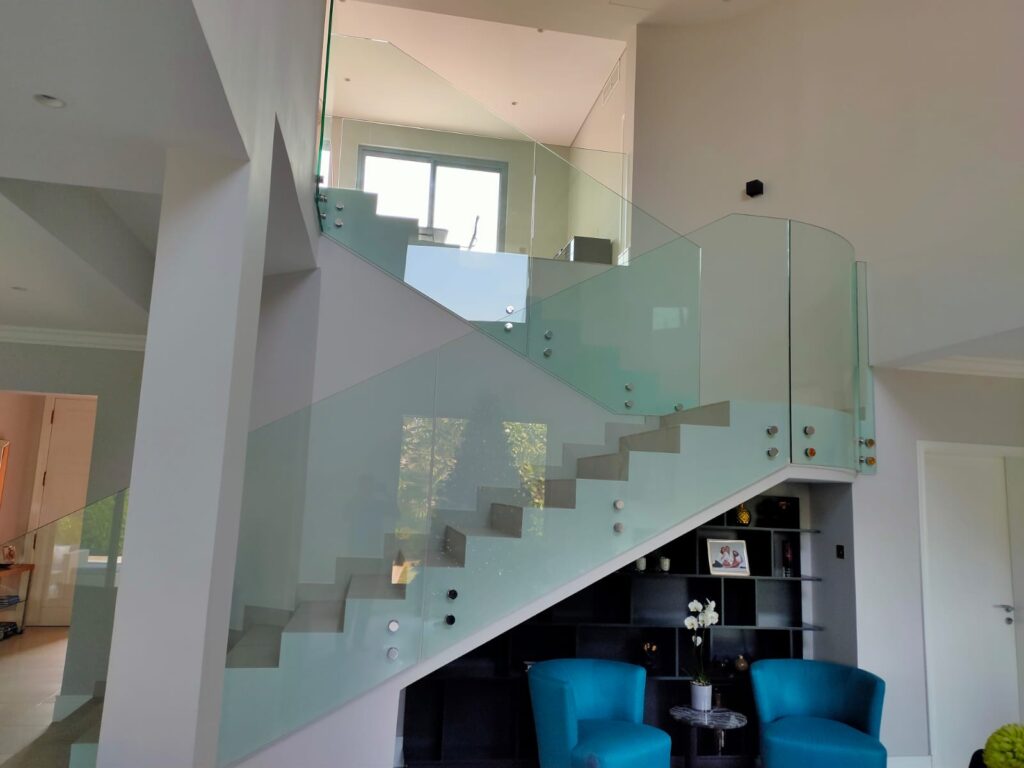
Curved glass balustrades offer safety without sacrificing views. The flagship store in Dubai Mall features “18 curved glass panels with a non-visible steel shoe” for its internal and external balustrades, achieving a clean, minimalist aesthetic.
Curtain Walls and Facades
Large-scale curved glass curtain walls are defining Dubai’s commercial skyline. The Opus project by Zaha Hadid Architects features a “fully engineered curved glass curtain wall” with 3D double-curved glazing.
Interior Design Elements
Beyond exteriors, curved glass is increasingly used for:
- Curved glass partitions
- Feature walls and cladding
- Shower enclosures
- Curved mirrors
- Glass staircases
Curved Glass Fabrication: How It Works
Understanding the fabrication process helps project stakeholders appreciate the craftsmanship and technical expertise required for curved glass solutions for luxury projects.
The Hot-Bending Process
Hot-bending remains the most common method for producing curved glass. The process involves:
- Cutting: Flat glass is cut to the required size
- Heating: Glass is heated in a furnace to approximately 600°C, reaching its softening point
- Shaping: The softened glass is formed over a mould or between rollers to achieve the desired curvature
- Annealing: The glass is slowly cooled to relieve internal stresses
- Tempering (optional): For safety glass, the curved glass undergoes thermal tempering
For projects requiring extra-large curved tempered glass, manufacturers must precisely control “glass dimensions and curvature to ensure every piece met installation and appearance requirements”, often conducting “multiple rounds of process testing…to guarantee smooth curve transitions and structural stability”.
Cold-Bending Technology
Cold-bending is an innovative alternative gaining traction in Dubai. Instead of heating the glass, cold-bending uses structural framing to gently bend the glass at ambient temperature. This technique was employed at the Wasl Tower, where “cold-bent glazing, allowing the glass to follow the tower’s curvature without breaking the visual continuity”.
Cold-bending offers several advantages:
- Lower energy consumption
- Faster production times
- Cost savings for large-radius curves
- Reduced risk of optical distortion
However, cold-bending is limited to gentler curves and requires careful engineering to ensure structural integrity.
Quality Control
Given Dubai’s extreme climate, quality control is paramount. Curved glass must withstand:
- Temperatures exceeding 45°C in summer
- Significant thermal expansion and contraction
- Sand and dust exposure
- High wind loads
Reputable suppliers like Glasser UAE implement rigorous quality control protocols throughout the fabrication process.
Curved Glass Cost Guide for Dubai (2026)
Pricing for curved glass solutions for luxury projects in Dubai varies significantly based on multiple factors. Understanding these cost drivers enables better budget planning.
Estimated Cost Ranges
| Component | Low (AED) | Average (AED) | High (AED) | Notes |
|---|---|---|---|---|
| Material (glass type) | 1,500 | 4,400 | 12,800 | Annealed, tempered, or laminated options |
| Fabrication & shaping | 2,200 | 7,350 | 18,400 | Radius, thickness, edge work |
| Installation | 2,950 | 9,200 | 25,700 | Includes framing, sealing, and fixing |
| Engineering & design | 1,100 | 3,700 | 8,100 | Structural calculations, shop drawings |
| Delivery & logistics | 550 | 1,800 | 5,500 | Crating, transportation, import duties |
Note: Ranges are estimates based on international benchmarks and Dubai market conditions. Actual costs depend on project specifications.
Price Per Square Foot
For budgeting purposes, curved glass typically ranges from AED 400–1,200 per square foot for fully installed solutions. The wide range reflects:
- Radius: Tighter curves (smaller radius) cost significantly more due to precision requirements
- Glass type: Laminated and Low-E coated glass add 30–50% to material costs
- Size: Larger panels require specialised handling and equipment
- Complexity: Double-curved glass is substantially more expensive than single-curve
Cost-Saving Strategies
- Choose larger radius curves: Gentler bends are less expensive to produce
- Standardise thickness: Avoid custom thicknesses where possible
- Plan ahead: Rush orders attract significant premiums
- Combine with flat glass: Use curved glass for feature elements only
- Work with local specialists: Reduce logistics costs and import duties
Curved Glass vs. Flat Glass: Comparison Table
| Feature | Curved Glass | Flat Glass |
|---|---|---|
| Aesthetic | Fluid, organic, seamless | Linear, traditional |
| View obstruction | Minimal (fewer mullions) | More mullions required |
| Cost per sq ft | AED 400–1,200 | AED 150–400 |
| Lead time | 6–12 weeks | 2–4 weeks |
| Fabrication complexity | High | Low |
| Structural engineering | Specialised required | Standard |
| Installation | Specialist teams needed | Standard glazing teams |
| Best for | Iconic facades, feature elements | Standard glazing, cost-sensitive projects |
Notable Curved Glass Projects in Dubai
Dubai boasts some of the world’s most impressive curved glass installations.
1. Apple Dubai Mall
Engineered by Eckersley O’Callaghan, this project features an “11-metre-high curved, south-facing, glass facade” spanning 56.6 metres across two floors. The facade incorporates 18 motorised ‘Solar Wings’ that respond to Dubai’s extreme environmental conditions.
2. Wasl Tower (Mandarin Oriental Downtown)
This twisting tower on Sheikh Zayed Road employs cold-bent glazing to follow the building’s unique geometry. Each curtain wall module is unique, factory-assembled for precision, and aligned to the tower’s rotation.
3. The Opus
Designed by Zaha Hadid Architects, The Opus features a 20-storey fully glazed building “resembling a cube with the core melted out”. The project’s 3D double-curved shape presented significant fabrication challenges.
4. Dubai Harbour Residences
This low-rise luxury development features “curved glass corners that promise uninterrupted panoramic views of the sea and the city”, demonstrating how curved glass enhances residential luxury.
5. Armani Beach Residences, Palm Jumeirah
Designed by Tadao Ando, this 53-home development features curved terraces and a glass and concrete facade, exemplifying curved glass in ultra-luxury residential settings.
Choosing the Right Curved Glass Partner in Dubai
Selecting the right partner for curved glass solutions for luxury projects is critical. Here’s what to look for:
1. Technical Expertise
Your partner should demonstrate deep understanding of:
- Glass bending technologies (hot-bent, cold-bent)
- Dubai’s building codes and climate requirements
- Structural engineering principles
- Quality assurance protocols
2. Project Portfolio
Review past projects similar to yours. Look for:
- Luxury residential and commercial projects
- Complex curved glass installations
- Projects completed in Dubai’s climate
3. End-to-End Capability
The ideal partner offers comprehensive services:
- Design consultation
- Engineering and shop drawings
- Fabrication
- Logistics and delivery
- Professional installation
- After-sales support
4. Local Presence
Working with a Dubai-based specialist offers advantages:
- Understanding of local regulations
- Established supply chains
- Faster response times
- On-site support capability
Why Glasser UAE for Curved Glass Solutions
Glasser UAE (Glasser Technical Works) stands as a trusted name in glass and aluminium solutions across Dubai, Sharjah, and the UAE. With expertise spanning glass partitions, aluminium fabrication, glass railings, and commercial glass solutions, Glasser UAE brings comprehensive capabilities to luxury projects.
Why choose Glasser UAE:
- Local expertise: Deep understanding of Dubai’s construction landscape and regulatory environment
- Comprehensive services: From design consultation to fabrication and installation
- Quality commitment: Rigorous quality control for Dubai’s demanding climate
- Luxury focus: Proven track record in high-end residential and commercial projects
- Client-centric approach: Tailored solutions for each project’s unique requirements
Frequently Asked Questions
Conclusion
Curved glass solutions for luxury projects represent the pinnacle of architectural glazing in Dubai. From the iconic curves of the Wasl Tower to the seamless facades of luxury villas, curved glass delivers the fluid aesthetics, uninterrupted views, and premium quality that define Dubai’s most prestigious developments.
As Dubai continues to push architectural boundaries, the demand for sophisticated curved glass solutions will only grow. Whether you are developing a luxury villa, a high-end retail space, or a commercial landmark, curved glass offers the distinction and quality that sets your project apart.
Ready to transform your luxury project with curved glass?
Contact Glasser UAE today for expert consultation, bespoke fabrication, and professional installation. Our team of specialists will guide you through every step of the process, ensuring your curved glass vision becomes reality.
Related Services from Glasser UAE
References
- Eckersley O’Callaghan. “Apple Dubai Mall.” eocengineers.com.
- Technal. “Mandarin Oriental Downtown, Dubai (Wasl Tower).” technal.com.
- Design Middle East. “Inside Dubai Harbour Residences with Fadi Jabri.” design-middleeast.com.
- Love That Design. “Palm Hills Villa 42, Dubai.” lovethatdesign.com.
- Khales Project. “The Al Khawaneej Organic Villa.” khales.ae.
- AEWORLDMAP. “Armani Beach Residences at Palm Jumeirah.” aeworldmap.com.
- Well Built Florida. “Curved Glass Windows Cost Guide 2026.” wellbuiltflorida.com.
- Evolo. “The Opus, Mixed-Use Development in Dubai / Zaha Hadid.” evolo.us.
Disclaimer: Cost estimates and lead times are indicative and subject to project-specific requirements. Contact Glasser UAE for accurate quotations.